Crunch Form: 6 Mistakes a Physical Therapist Often Corrects

Medically reviewed by Devanshi Modi, PT, Cert. MDT, CMP — licensed physical therapist with over 15 years of clinical experience.
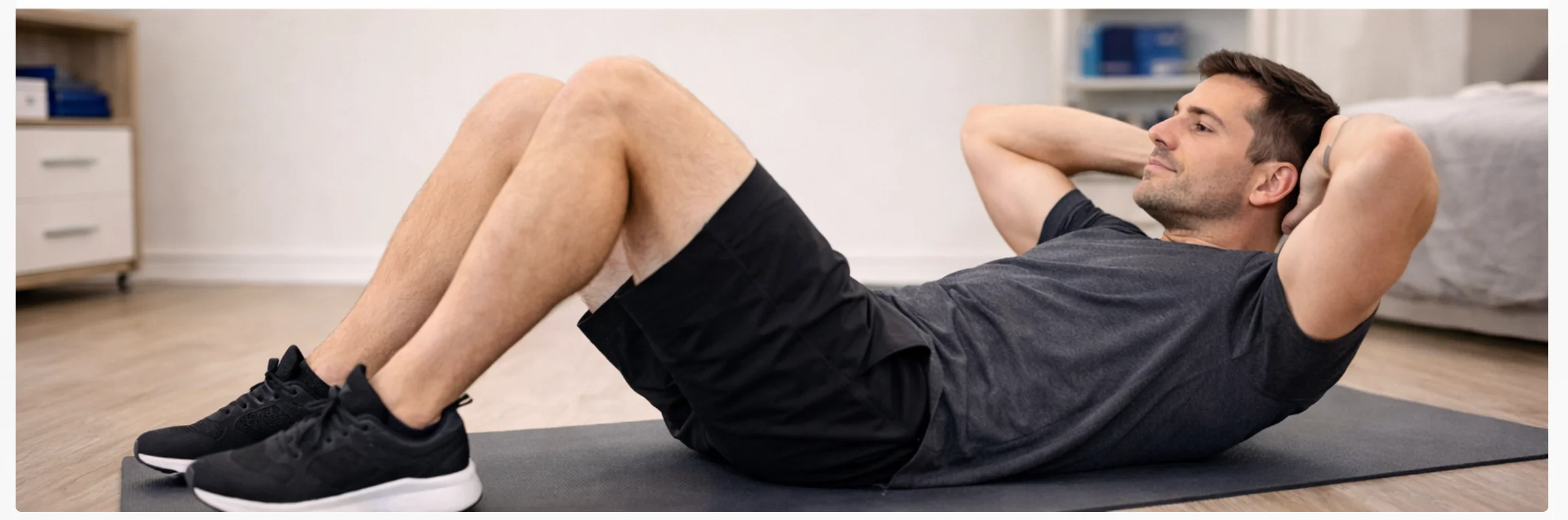
Doing crunches as part of your ab workout? Check your form first.
If you do lots of crunches, sit-ups or curls to get a flat belly, or as part of an ab workout you picked up from YouTube videos or blogs, this post is for you. One thing worth knowing first: ab exercises like crunches can build abdominal muscle endurance, but on their own they may not shrink your belly. In a small 6-week trial of 24 healthy, inactive adults who kept their usual calorie intake, those who did ab exercises 5 days a week could do more curl-ups afterward than a group that did not exercise, but their belly fat and waist measurements did not change.[1]
Here are 6 form mistakes we often help people correct in our clinic.
1. Holding Your Breath
In our clinic, we teach a gentle draw-in of the belly button before you curl up, while you keep breathing. The draw-in on its own works your deepest abdominal muscle, the transversus abdominis: in an ultrasound study of 120 healthy adults, drawing in thickened this muscle with little change in the next muscle layer up, although a crunch on its own thickened it too.[2] Try breathing out slowly as you curl up. In a small study of 12 healthy adults, breathing out slowly during curl-ups lowered neck muscle activity and increased activity in the deeper side-abdominal muscles (the internal oblique/transversus abdominis area) compared with breathing in.[3]
2. Sitting Up Too High
Gently lift your shoulders until your shoulder blades and upper back are off the mat. Once your shoulder blades are off the mat, sitting up the rest of the way brings your hip flexor muscles in much more. In a small lab study using fine-wire sensors, every type of full sit-up activated a deep hip flexor muscle (the psoas) more than a partial curl-up did.[4]
So going higher doesn't mean your abs are working harder. In a lab study of 14 adults, the crunch was among the exercises with the highest activity in the main ab muscle (rectus abdominis), while the full bent-knee sit-up was among those with the highest activity in a hip flexor muscle (rectus femoris).[5] A review of abdominal exercise research likewise favors exercises that curl the spine without active hip bending, and advises against having your feet held down.[6]
3. Arching Your Back
In our clinic, we watch that your low back doesn't arch up off the mat during the curl. If it does, we make the exercise easier (for example, by changing your arm position, below) until you can control the movement.
4. Arm Position
Where you put your arms changes how hard the exercise is. In a tiny lab study of 3 people doing curl-ups with their hips and knees bent to 90 degrees, curl-ups with the arms along the body used the main abdominal muscle (rectus abdominis) the least, and curl-ups with the arms stretched overhead used it the most.[7] In a study of 10 healthy women, switching to a harder arm position increased activity in all the abdominal muscles.[8] So in these small studies, arms by your sides was the easiest version and arms overhead the hardest. In our clinic, we often use arms crossed on the chest as an in-between step.
5. Straining Your Neck
Don't lead the movement with your chin or pull on your head, and keep your neck in line with your body. A review of abdominal exercise research advises against pulling with your hands behind your head.[6] Breathing out slowly as you curl up may also help: in the small study mentioned in step 1, it lowered activity in a front-of-neck muscle (the sternocleidomastoid) during curl-ups.[3]
6. Using Shoulder Muscles to Do the Curl
In our clinic, we coach people to lift with their tummy muscles rather than reaching forward with the arms or shrugging the shoulder blades to get up.
To meet a certified McKenzie therapist in East Brunswick, call 551-208-3234 at Spineck Physical Therapy.
References
- Vispute SS, Smith JD, LeCheminant JD, et al. The effect of abdominal exercise on abdominal fat. J Strength Cond Res. 2011;25(9):2559-2564. doi:10.1519/JSC.0b013e3181fb4a46 · PubMed
- Teyhen DS, Rieger JL, Westrick RB, et al. Changes in deep abdominal muscle thickness during common trunk-strengthening exercises using ultrasound imaging. J Orthop Sports Phys Ther. 2008;38(10):596-605. doi:10.2519/jospt.2008.2897 · PubMed
- Yoon TL, Kim KS, Cynn HS. Slow expiration reduces sternocleidomastoid activity and increases transversus abdominis and internal oblique muscle activity during abdominal curl-up. J Electromyogr Kinesiol. 2014;24(2):228-232. doi:10.1016/j.jelekin.2013.10.003 · PubMed
- Juker D, McGill S, Kropf P, et al. Quantitative intramuscular myoelectric activity of lumbar portions of psoas and the abdominal wall during a wide variety of tasks. Med Sci Sports Exerc. 1998;30(2):301-310. doi:10.1097/00005768-199802000-00020 · PubMed
- Escamilla RF, McTaggart MS, Fricklas EJ, et al. An electromyographic analysis of commercial and common abdominal exercises: implications for rehabilitation and training. J Orthop Sports Phys Ther. 2006;36(2):45-57. doi:10.2519/jospt.2006.36.2.45 · PubMed
- Monfort-Pañego M, Vera-García FJ, Sánchez-Zuriaga D, et al. Electromyographic studies in abdominal exercises: a literature synthesis. J Manipulative Physiol Ther. 2009;32(3):232-244. doi:10.1016/j.jmpt.2009.02.007 · PubMed
- Rutkowska-Kucharska A, Szpala A. Electromyographic muscle activity in curl-up exercises with different positions of upper and lower extremities. J Strength Cond Res. 2010;24(11):3133-3139. doi:10.1519/JSC.0b013e3181ddb308 · PubMed
- Crommert ME, Bjerkefors A, Tarassova O, et al. Abdominal muscle activation during common modifications of the trunk curl-up exercise. J Strength Cond Res. 2021;35(2):428-435. doi:10.1519/JSC.0000000000002439 · PubMed
This article is for general education and is not a substitute for an individual evaluation by a licensed clinician.
Need Help With Your Condition?
If you're experiencing pain or have questions about physical therapy, schedule an appointment with our Certified McKenzie Therapist.
This article is for educational purposes only and is not a substitute for professional medical advice, diagnosis, or treatment. Always consult a licensed healthcare provider about your specific condition.