Physical Therapy After a Car Accident in Middlesex County

Medically reviewed by Devanshi Modi, PT, Cert. MDT, CMP — licensed physical therapist with over 15 years of clinical experience.
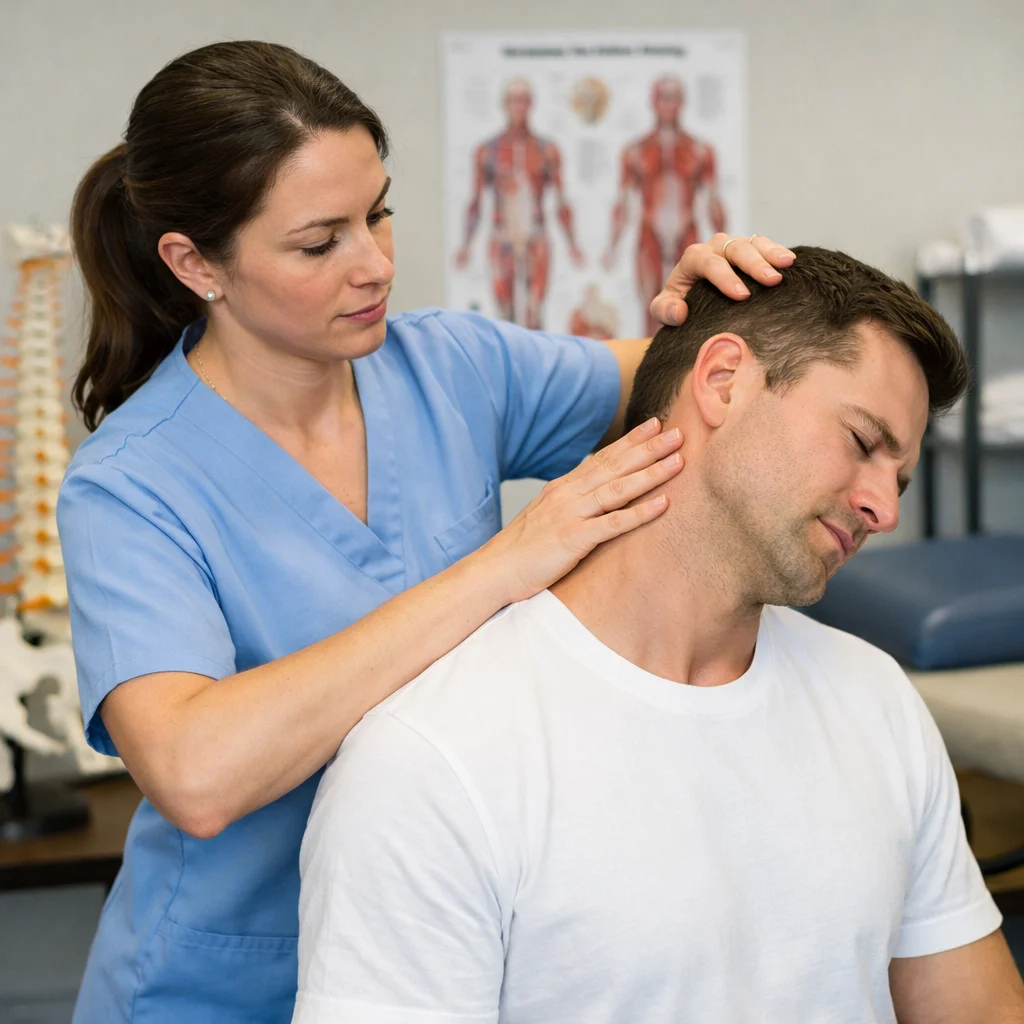
If you've been in a car accident in Middlesex County, you know how disorienting and painful the aftermath can be. Even minor injuries can be painful for weeks: in a large U.S. study of adults seen in emergency departments after car crashes, almost all of whom had only minor injuries, about half had moderate or severe neck, shoulder, or back pain six weeks later.[1] Details of the crash itself, such as the direction of impact, generally don't predict how well people recover from whiplash.[2] Many people improve, but symptoms can linger: about half of people with whiplash still report some neck pain a year after their injury.[2] This guide explains common injuries, what recovery usually looks like, and what to expect from physical therapy.
Common Car Accident Injuries
Whiplash
Whiplash is a neck injury caused by a sudden acceleration-deceleration (back-and-forth) movement of the head and neck, and it is very common after car accidents.[3] Symptoms can include:[4]
- Neck pain and stiffness[5]
- Headaches (often felt at the back of the head or base of the skull)[6]
- Upper back pain, including around the shoulder blades[7]
- Dizziness
- Fatigue
Low Back Pain
Low back pain is also common after a collision. In the large U.S. emergency-department study mentioned above, moderate or severe low back pain was as common as neck pain six weeks after a crash (37% each).[1] In that study, pain in the neck, shoulders, and back also interfered with daily life more than pain in other parts of the body.[1]
Pain in Other Areas
Pain after a crash isn't always limited to the neck and back. The same study tracked pain in 20 body areas and found that pain across all areas explained nearly twice as much about how much pain interfered with daily life as neck pain alone.[1] Other areas that can hurt after a crash include:[1]
- Shoulders and arms
- Hips and legs
- Chest
- Jaw
What Recovery Usually Looks Like
It's natural to wait and see whether pain settles on its own, and for many people it does improve.[8] Here is what research shows:
- Most improvement tends to happen early - For people with whiplash, pain and disability tend to ease fastest in the first 3 months after the crash, and recovery tends to level off after that.[8]
- Some factors are linked with slower recovery - Higher pain and disability early on, and things like fear of movement, low mood, or a passive coping style, are linked with slower or less complete recovery.[2]
- Staying active is recommended - A clinical practice guideline on neck pain, developed for managing traffic injuries, recommends explaining that these injuries usually are not serious and tend to settle with time, and encouraging people to keep active and moving.[9] For recent whiplash without signs of nerve involvement, a research review found that simple care built on reassurance, advice to stay active, and getting back to regular activities may be an option.[10]
What to Expect from Physical Therapy After an Accident
Initial Evaluation
Your first visit is a thorough assessment of your injuries. It starts with checking for signs of a more serious problem that needs a doctor's attention, as a clinical practice guideline recommends,[9] and includes:
- Range of motion testing
- Muscle strength evaluation
- Neurological screening
- Functional movement assessment
Treatment Approach
Depending on your injuries, treatment may include:
- Manual therapy (hands-on techniques), combined with exercise and education. A research review found that this kind of combined care may help people with whiplash or neck pain who don't have signs of nerve involvement.[10]
- McKenzie Method (MDT) assessment and repeated-movement exercises. In one randomized trial of 97 people with whiplash, a program of frequent active neck movements plus McKenzie-based assessment and treatment reduced pain and sick leave more than the older approach of rest, a soft collar, and gradual self-mobilization.[11] For neck pain in general, a review of five trials found that the added benefit of this method over other approaches, or over waiting to see, may be too small to matter for pain and was too small to matter for disability, although not all therapists in those trials had the highest level of McKenzie training.[12]
- Therapeutic exercise and other active treatment, aimed at getting you moving and back to your usual activities. In trials of recent whiplash injuries, active treatments reduced pain more than passive ones at 6 months and up to 3 years later (but not in the first 3 months), although the evidence was rated low to very low quality.[13]
- Education and reassurance about your injury, its usual course, and how to stay active[9]
- Strategies to manage pain and pace your return to normal activities
Progress Monitoring
Your progress is reassessed as you go, so your plan can change as you recover. A clinical practice guideline recommends checking progress at every visit and discharging people once they've recovered.[9] More treatment isn't automatically better: a research review found that people with whiplash or neck pain who received high-intensity care tended to have poorer outcomes than those who had fewer treatments.[10]
Insurance and Car Accident Claims
In New Jersey, your auto insurance typically covers physical therapy through Personal Injury Protection (PIP). Important points:
- You have the right to choose your own physical therapist
- Treatment should begin as soon as medically appropriate
- Proper documentation supports your claim
Serving Middlesex County
Spineck Physical Therapy in East Brunswick is conveniently located for accident victims throughout Middlesex County:
- New Brunswick - 5 minutes via Route 18
- Edison - 10 minutes via Route 1
- South Brunswick - 10 minutes
- North Brunswick - 8 minutes
- Old Bridge - 10 minutes
Why Choose One-on-One Care After an Accident
At Spineck PT, we plan your care around your specific injuries:
- Every session is one-on-one with your therapist
- No double-booking or aide supervision
- Detailed documentation for your insurance claim
- Care from a McKenzie-certified (Cert. MDT) physical therapist
When to Get Help
Research doesn't show that you need to start treatment within days of a crash. In studies of people with recent whiplash, starting treatment within the first few days generally gave similar results to starting 1 to 2 weeks later.[13] One trial did find that people who began active neck exercises within 4 days were the only group whose neck movement three years later matched that of people who hadn't been in a crash, although in that same trial, starting 2 weeks later did not change pain or sick leave.[11] If you've been in a car accident in Middlesex County and your pain, stiffness, or limited movement isn't improving, or it's getting in the way of work, sleep, or daily life, an evaluation can help you get a clear plan. If your symptoms get worse or new symptoms appear, see a physician promptly.[9]
Been in a car accident? Get the specialized care you need. Call 551-208-3234 to schedule your evaluation at Spineck Physical Therapy in East Brunswick.
References
- Bortsov AV, Platts-Mills TF, Peak DA, et al. Effect of pain location and duration on life function in the year after motor vehicle collision. Pain. 2014;155(9):1836-1845. doi:10.1016/j.pain.2014.06.013 · PubMed
- Carroll LJ, Holm LW, Hogg-Johnson S, et al. Course and prognostic factors for neck pain in whiplash-associated disorders (WAD): results of the Bone and Joint Decade 2000-2010 Task Force on Neck Pain and Its Associated Disorders. Spine (Phila Pa 1976). 2008;33(4 Suppl):S83-S92. doi:10.1097/BRS.0b013e3181643eb8 · PubMed
- Conlin A, Bhogal S, Sequeira K, et al. Treatment of whiplash-associated disorders—part I: non-invasive interventions. Pain Res Manag. 2005;10(1):21-32. doi:10.1155/2005/503704 · PubMed
- Ferrari R, Russell AS, Carroll LJ, et al. A re-examination of the whiplash associated disorders (WAD) as a systemic illness. Ann Rheum Dis. 2005;64(9):1337-1342. doi:10.1136/ard.2004.034447 · PubMed
- Sterling M, Jull G, Vicenzino B, et al. Development of motor system dysfunction following whiplash injury. Pain. 2003;103(1-2):65-73. doi:10.1016/s0304-3959(02)00420-7 · PubMed
- Anarte-Lazo E, Abichandani D, Rodriguez-Blanco C, et al. Headache features in people with whiplash associated disorders: a scoping review. Musculoskelet Sci Pract. 2023;66:102802. doi:10.1016/j.msksp.2023.102802 · PubMed
- Heneghan NR, Smith R, Tyros I, et al. Thoracic dysfunction in whiplash associated disorders: a systematic review. PLoS One. 2018;13(3):e0194235. doi:10.1371/journal.pone.0194235 · PubMed
- Kamper SJ, Rebbeck TJ, Maher CG, et al. Course and prognostic factors of whiplash: a systematic review and meta-analysis. Pain. 2008;138(3):617-629. doi:10.1016/j.pain.2008.02.019 · PubMed
- Côté P, Wong JJ, Sutton D, et al. Management of neck pain and associated disorders: a clinical practice guideline from the Ontario Protocol for Traffic Injury Management (OPTIMa) Collaboration. Eur Spine J. 2016;25(7):2000-2022. doi:10.1007/s00586-016-4467-7 · PubMed
- Sutton DA, Côté P, Wong JJ, et al. Is multimodal care effective for the management of patients with whiplash-associated disorders or neck pain and associated disorders? A systematic review by the Ontario Protocol for Traffic Injury Management (OPTIMa) Collaboration. Spine J. 2016;16(12):1541-1565. doi:10.1016/j.spinee.2014.06.019 · PubMed
- Rosenfeld M, Seferiadis A, Carlsson J, et al. Active intervention in patients with whiplash-associated disorders improves long-term prognosis: a randomized controlled clinical trial. Spine (Phila Pa 1976). 2003;28(22):2491-2498. doi:10.1097/01.BRS.0000090822.96814.13 · PubMed
- Takasaki H, May S. Mechanical diagnosis and therapy has similar effects on pain and disability as 'wait and see' and other approaches in people with neck pain: a systematic review. J Physiother. 2014;60(2):78-84. doi:10.1016/j.jphys.2014.05.006 · PubMed
- Wiangkham T, Duda J, Haque S, et al. The effectiveness of conservative management for acute whiplash associated disorder (WAD) II: a systematic review and meta-analysis of randomised controlled trials. PLoS One. 2015;10(7):e0133415. doi:10.1371/journal.pone.0133415 · PubMed
This article is for general education and is not a substitute for an individual evaluation by a licensed clinician.
Need Help With Your Condition?
If you're experiencing pain or have questions about physical therapy, schedule an appointment with our Certified McKenzie Therapist.
This article is for educational purposes only and is not a substitute for professional medical advice, diagnosis, or treatment. Always consult a licensed healthcare provider about your specific condition.