Herniated Disc Treatment in East Brunswick, NJ: Do You Need Surgery?

Medically reviewed by Devanshi Modi, PT, Cert. MDT, CMP — licensed physical therapist with over 15 years of clinical experience.
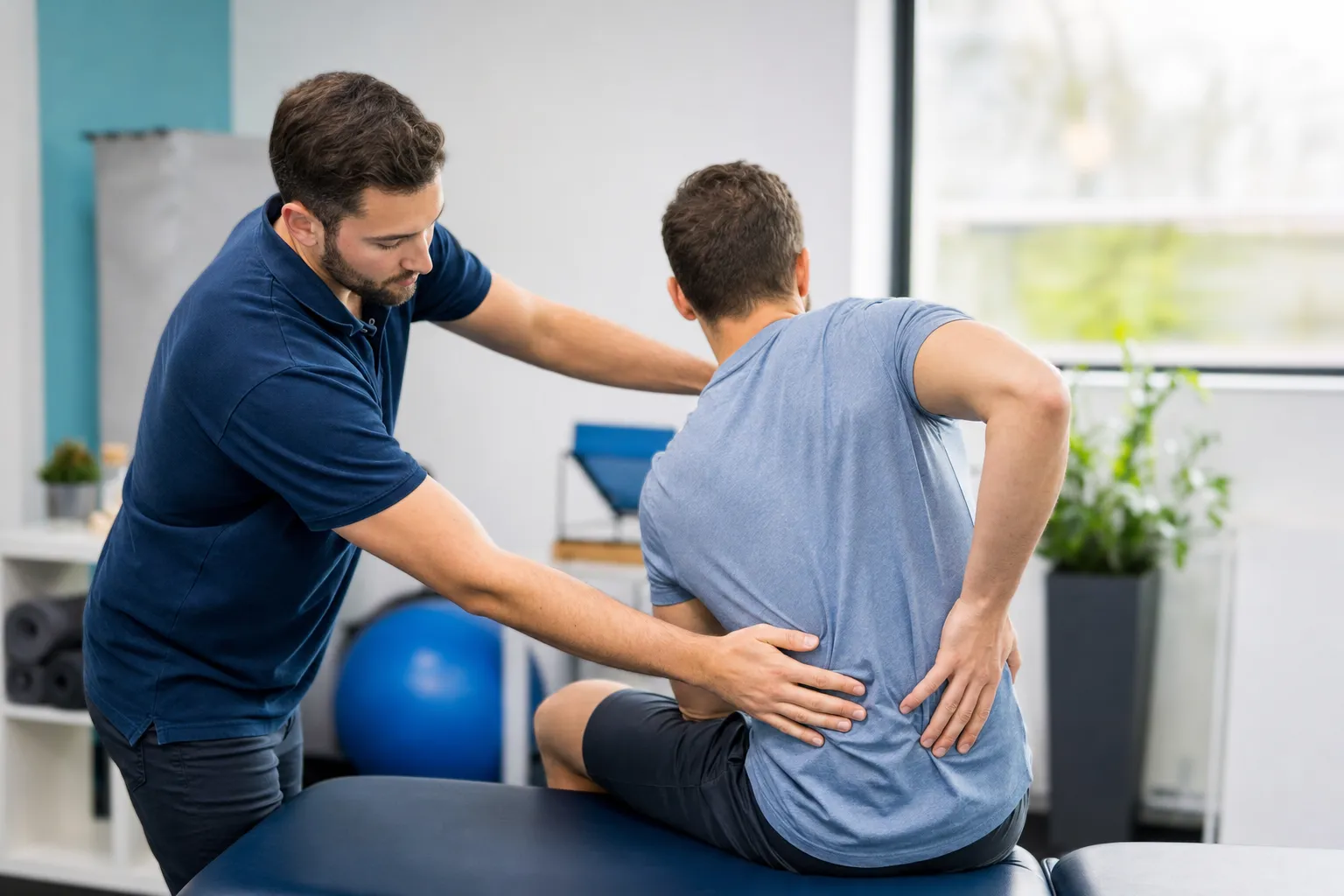
A herniated disc can be very painful and worrying. If you're in East Brunswick, NJ or the surrounding Middlesex County area and dealing with a herniated disc, Spineck Physical Therapy offers one-on-one, non-surgical care for disc-related back, neck and nerve pain. Many people with a herniated disc improve without surgery,[1][2] and our goal is to help you understand your options and get back to your normal activities.
What Is a Herniated Disc?
Your spine is made up of bones (vertebrae) stacked on top of each other, with discs in between. Each disc has a softer, gel-like center.[3] A herniated disc (sometimes called a slipped or ruptured disc) is when part of a disc pushes out beyond its normal edge, where it can press on a nearby nerve root.[1]
Herniated discs can affect different parts of the spine. The two areas we see most often in our clinic are:
- Lumbar spine (lower back) — can cause back pain and sciatica, pain that travels down the leg[1]
- Cervical spine (neck) — can cause neck pain and pain that spreads into the arm[3]
Herniated Disc Symptoms
Lumbar Herniated Disc
Symptoms vary from person to person and can include:
- Low back pain — although when a nerve root is pinched, leg pain that is worse than back pain is one of the clues linked with it[4]
- Pain that spreads into the buttock, thigh, calf, or foot (sciatica)[1]
- Numbness or tingling in the leg or foot
- Weakness in the leg muscles
- Pain that increases when you cough, sneeze, or strain[4]
Symptoms alone can't confirm a herniated disc. In a study of 395 people with severe sciatica, six standard history questions (age, sex, leg pain worse than back pain, numbness, weakness, and more pain when coughing, sneezing or straining) did a poor job of predicting what an MRI would show.[4] That's why a full assessment looks at the whole picture.
Cervical Herniated Disc
Symptoms can include:
- Neck pain
- Pain that spreads into one arm
- Numbness or tingling in the fingers or hand
- Weakness in the arm or hand[3]
What Raises the Risk of a Herniated Disc?
Much of the research on risk looks at sciatica, the nerve-related leg pain that a herniated disc in the lower back can cause.[1] In studies of workers, sciatica has been linked with:
- Heavy, physically demanding work[5]
- Bending or twisting the trunk, and lifting and carrying — especially in combination, with the risk rising the more years someone does this kind of work[5]
In the same review, sitting and professional driving were not significantly linked with sciatica, so in this research, sitting at work and driving for a living, on their own, weren't shown to raise the risk.[5]
Age-related changes are also very common: disc degeneration shows up on CT or MRI scans in about 37% of 20-year-olds and 96% of 80-year-olds with no back pain, and many of these changes are likely a normal part of aging rather than a cause of pain.[6]
Symptoms don't always start with an injury, either. In a study of people with severe sciatica, a gradual (not sudden) onset was actually one of the clues linked with finding a herniated disc on MRI.[4]
Our Approach to Herniated Discs: The McKenzie Method (MDT)
At Spineck Physical Therapy in East Brunswick, we use the McKenzie Method (Mechanical Diagnosis and Therapy) as our primary approach for treating herniated discs. It isn't a one-size-fits-all protocol — it's a structured assessment that aims to find the movements and positions that ease your specific symptoms.
What McKenzie Care Involves for a Herniated Disc
- Mechanical Assessment — Using repeated movements and positions, we look for a "directional preference": a direction of movement that reduces your pain or makes it centralize (move back toward the spine). Not everyone has one — in studies of people with spinal pain, about two in three showed centralization or a directional preference, and about one in three showed neither.[7]
- Self-Treatment Exercises — If you have a preferred direction, you learn specific exercises in that direction (for example, the McKenzie press-up if your symptoms ease when you bend backward) to do at home several times a day
- Progressive Loading — As your symptoms improve, your exercises are progressed to help you get back to your usual activities
- Education — You learn what may be contributing to your symptoms and how to manage flare-ups on your own
What Research Says About Exercise-Based Care for Sciatica
We're not aware of any study that has compared the McKenzie Method directly with surgery, so we can't say it works as well as an operation. Here is what research does show:
- In a randomized trial of 181 people with severe sciatica whose symptoms and exam findings would normally qualify them for surgery, exercises chosen according to each person's symptom response led to more improvement in most outcomes than sham exercises — and both groups improved substantially.[8]
- In a smaller trial of 66 people with sciatica and an MRI-confirmed disc herniation, seven visits of McKenzie-based exercise plus an education book gave results similar to a single session of guideline-based advice over two years, including similar surgery rates.[9]
One sign we watch for is centralization — leg or arm pain retreating toward the spine during testing. Centralization and having a directional preference are linked with a better outlook, mainly in studies of people with low back pain (evidence in neck pain is more limited).[7] It's an encouraging sign, not a guarantee.
Do You Need Surgery for a Herniated Disc?
Many people with a herniated disc do not need surgery.[2] In a trial of 283 people with severe sciatica lasting 6 to 12 weeks, about 6 in 10 of those assigned to non-surgical care had not had surgery a year later.[2] Most people with a herniated disc in the neck that causes arm pain also recover, with substantial improvement usually within the first 4 to 6 months.[10]
Herniated disc material in the lower back can also shrink on its own: in a review of people managed without surgery, follow-up scans showed regression in about 70% of extruded discs, 41% of protruding discs and 96% of fully separated (sequestered) fragments.[11]
Surgery still has an important place. For people with sciatica from a herniated disc who qualify for surgery, removing the herniated part of the disc (discectomy) relieves leg pain faster than non-surgical care, but the advantage shrinks over time and is negligible by one year (the evidence for this is of very low to low certainty).[12] Surgery is generally considered when:
- Pain and function haven't improved with non-surgical treatment and your imaging matches your symptoms[13]
- You have significant (moderate-to-severe) leg weakness from the disc — AO Spine expert recommendations advise surgery within about 3 days in that case to give the best chance of full nerve recovery[14]
- You want faster relief and feel that outweighs the risks and costs of an operation — a reasonable choice to discuss with a spine surgeon[12][14]
- You have signs of cauda equina syndrome — such as numbness in the "saddle" area (between your legs, around your bottom and inner thighs) or new bladder or bowel problems. This is a medical emergency.[15]
At Spineck PT, we start with non-surgical care when it's appropriate, and we refer you promptly to a physician or spine surgeon if you have warning signs or aren't improving as expected.
How One-on-One Sessions Work for Herniated Discs
People with back and neck pain respond to repeated movements differently — some have a clear preferred direction and some don't[7] — so we pay close attention to how your symptoms respond. At Spineck Physical Therapy:
- Every session is one-on-one with your therapist — no double-booking, no aides
- Immediate feedback — Your therapist monitors your response to each exercise in real time
- Adjusted treatment — If an approach isn't working, we modify it immediately
- Thorough education — You leave understanding exactly what to do at home and what to avoid
This lets us adjust your plan as your symptoms change.
Convenient East Brunswick Location
Spineck Physical Therapy is located at 646 NJ-18 North, Suite 110 (Building B), in East Brunswick, NJ. We're conveniently located for patients from throughout Middlesex County:
- New Brunswick — 5 minutes via Route 18
- North Brunswick — 8 minutes via Route 1 or Route 130
- South River — 8 minutes via Route 18
- Milltown — 7 minutes via Ryders Lane
- Sayreville — 12 minutes via Route 9
Free parking is available directly outside our building. We offer appointments Monday through Friday, 8:30am to 8pm.
When to Seek Treatment
You don't have to wait it out on your own. Consider getting evaluated if you have:
- Back or neck pain lasting more than a few days
- Pain radiating into your arm or leg
- Numbness or tingling in your extremities
- Weakness in your arm, hand, leg, or foot
- Pain that is getting progressively worse
- Difficulty with basic activities like walking, sitting, or sleeping
Get emergency care right away if you notice numbness in the "saddle" area (between your legs, around your bottom and inner thighs), or new trouble controlling your bladder or bowels.[15] New or worsening leg weakness is also a warning sign that needs prompt medical assessment.[15] If a disc is causing significant leg weakness, expert recommendations advise surgery within about 3 days to give the best chance of full nerve recovery.[14]
Start Your Recovery Today
A herniated disc diagnosis doesn't mean you need surgery, and it doesn't mean you'll be in pain forever.[2][11] In a large trial of people with severe sciatica, about 95% said they felt recovered within a year, whether they had early surgery or started with non-surgical care (surgery brought faster leg-pain relief).[2] Our role is to help you move and function as well as possible along the way. Learn more about our neck and back pain treatment services.
Dealing with a herniated disc in East Brunswick or Central NJ? Call 551-208-3234 to schedule your McKenzie Method evaluation at Spineck Physical Therapy. Our certified therapist has over 15 years of experience treating disc-related back and neck pain.
References
- van der Windt DA, Simons E, Riphagen II, et al. Physical examination for lumbar radiculopathy due to disc herniation in patients with low-back pain. Cochrane Database Syst Rev. 2010;(2):CD007431. doi:10.1002/14651858.CD007431.pub2 · PubMed
- Peul WC, van Houwelingen HC, van den Hout WB, et al. Surgery versus prolonged conservative treatment for sciatica. N Engl J Med. 2007;356(22):2245-2256. doi:10.1056/NEJMoa064039 · PubMed
- de Rooij JD, Verhagen AP, Harhangi BS, et al. Nucleoplasty for cervical radicular pain due to disc herniation. Cochrane Database Syst Rev. 2025;11(11):CD011852. doi:10.1002/14651858.CD011852.pub2 · PubMed
- Verwoerd AJ, Peul WC, Willemsen SP, et al. Diagnostic accuracy of history taking to assess lumbosacral nerve root compression. Spine J. 2014;14(9):2028-2037. doi:10.1016/j.spinee.2013.11.049 · PubMed
- Kuijer PPFM, Verbeek JH, Seidler A, et al. Work-relatedness of lumbosacral radiculopathy syndrome: review and dose-response meta-analysis. Neurology. 2018;91(12):558-564. doi:10.1212/01.wnl.0000544322.26939.09 · PubMed
- Brinjikji W, Luetmer PH, Comstock B, et al. Systematic literature review of imaging features of spinal degeneration in asymptomatic populations. AJNR Am J Neuroradiol. 2015;36(4):811-816. doi:10.3174/ajnr.A4173 · PubMed
- May S, Runge N, Aina A. Centralization and directional preference: an updated systematic review with synthesis of previous evidence. Musculoskelet Sci Pract. 2018;38:53-62. doi:10.1016/j.msksp.2018.09.006 · PubMed
- Albert HB, Manniche C. The efficacy of systematic active conservative treatment for patients with severe sciatica: a single-blind, randomized, clinical, controlled trial. Spine (Phila Pa 1976). 2012;37(7):531-542. doi:10.1097/BRS.0b013e31821ace7f · PubMed
- Kilpikoski S, Häkkinen AH, Repo JP, et al. The McKenzie Method versus guideline-based advice in the treatment of sciatica: 24-month outcomes of a randomised clinical trial. Clin Rehabil. 2024;38(1):72-84. doi:10.1177/02692155231196393 · PubMed
- Wong JJ, Côté P, Quesnele JJ, et al. The course and prognostic factors of symptomatic cervical disc herniation with radiculopathy: a systematic review of the literature. Spine J. 2014;14(8):1781-1789. doi:10.1016/j.spinee.2014.02.032 · PubMed
- Chiu CC, Chuang TY, Chang KH, et al. The probability of spontaneous regression of lumbar herniated disc: a systematic review. Clin Rehabil. 2015;29(2):184-195. doi:10.1177/0269215514540919 · PubMed
- Liu C, Ferreira GE, Abdel Shaheed C, et al. Surgical versus non-surgical treatment for sciatica: systematic review and meta-analysis of randomised controlled trials. BMJ. 2023;381:e070730. doi:10.1136/bmj-2022-070730 · PubMed
- Bernstein IA, Malik Q, Carville S, et al. Low back pain and sciatica: summary of NICE guidance. BMJ. 2017;356:i6748. doi:10.1136/bmj.i6748 · PubMed
- Vadalà G, Ambrosio L, Chen X, et al. AO Spine clinical practice recommendations: when to operate in lumbar disc herniation. Global Spine J. Published online September 22, 2026. doi:10.1177/21925682261492223 · PubMed
- Hennessy O, Devitt AT, Synnott K, et al. Assessment and early investigation of cauda equina syndrome: a systematic review of existing international guidelines and summary of the current evidence. Eur Spine J. 2025;34(4):1545-1551. doi:10.1007/s00586-025-08732-0 · PubMed
This article is for general education and is not a substitute for an individual evaluation by a licensed clinician.
Need Help With Your Condition?
If you're experiencing pain or have questions about physical therapy, schedule an appointment with our Certified McKenzie Therapist.
This article is for educational purposes only and is not a substitute for professional medical advice, diagnosis, or treatment. Always consult a licensed healthcare provider about your specific condition.